
Unlock Wealth: Smart Money Konzepte Explained
In the dynamic and often perplexing world of Forex trading, retail traders frequently find themselves at a disadvantage against the market’s true behemoths. These are the institutional players, the banks, hedge funds, and investment firms that collectively comprise what is known as “Smart Money.” Understanding the strategies and movements of these powerful entities is crucial for anyone serious about navigating the currency markets successfully. This comprehensive guide will demystify **Smart Money Konzepte**, revealing how these institutions operate, influence price action, and ultimately move the market, providing you with invaluable insights to refine your trading approach.
Far from being random fluctuations, market movements are often the result of deliberate actions by these large players. By learning to recognize their footprints, retail traders can align themselves with the prevailing institutional flow rather than constantly fighting against it. This paradigm shift in understanding market dynamics is at the core of mastering **Smart Money Konzepte**.
Was sind Smart Money Konzepte im Forex-Handel?
**Smart Money Konzepte** refer to a set of analytical frameworks and trading strategies based on the premise that large institutional traders leave discernible clues about their intentions in the market. Unlike individual retail traders, these institutions operate with vast capital, sophisticated algorithms, and direct access to liquidity providers. Their trades are so significant that they inherently impact supply and demand, leading to specific price patterns and structures.
The essence of these concepts is to “trade like the institutions.” This doesn’t mean having billions of dollars, but rather understanding their psychology, their objectives, and the technical patterns they create. By identifying areas where Smart Money is accumulating positions or distributing them, retail traders can anticipate potential directional moves and enter trades with higher probability.
Die Akteure: Wer sind die Smart Money Institutionen?
The term “Smart Money” encompasses a diverse group of entities that possess significant market power and information advantages. These include:
-
Investmentbanken: Global giants like JPMorgan Chase, Goldman Sachs, and Deutsche Bank execute massive trades on behalf of clients and for their proprietary desks. Their sheer volume dictates market direction.
-
Hedgefonds: These funds manage billions in assets and employ complex, often aggressive, strategies to generate returns. Their market entries and exits can create significant volatility.
-
Zentralbanken: Institutions like the Federal Reserve, European Central Bank, and Bank of Japan intervene in currency markets to implement monetary policy or stabilize their national currencies. Their actions are arguably the most impactful.
-
Große Vermögensverwalter: Pension funds and mutual funds, while often long-term investors, still execute trades large enough to influence specific currency pairs.
-
Multinationale Konzerne: Companies conducting international business need to exchange vast sums of currency, hedging against foreign exchange risk, which adds to market flow.
These entities operate with different mandates but share a common goal: to execute large orders with minimal market impact and maximum profitability. Their collective activity forms the backbone of **Smart Money Konzepte**.
Wie Smart Money den Markt bewegt: Strategien und Taktiken
The methods by which Smart Money influences the market are sophisticated and often designed to trap less informed traders. Understanding these tactics is vital for anyone applying **Smart Money Konzepte**.
Order Flow und Liquidität
At its core, institutional trading revolves around managing massive order flow. When a bank needs to buy or sell a large amount of a currency, they cannot simply hit a market order without causing significant slippage. Instead, they use various techniques to accumulate or distribute positions gradually, often around key price levels where liquidity is plentiful.
They look for areas of high liquidity, typically where many stop-loss orders are clustered, or where pending buy/sell orders reside. These areas become targets for “liquidity grabs,” where price is intentionally driven to these levels to fill institutional orders before reversing.
Stop Hunts und Liquidity Grabs
One of the most widely discussed aspects of **Smart Money Konzepte** is the concept of “stop hunts.” Institutions are aware of where retail traders typically place their stop-loss orders (e.g., just above resistance or below support). They might intentionally push the price past these levels to trigger a cascade of stop-loss orders, which provides the necessary liquidity for their large positions to be filled.
Once these stops are triggered, the market often reverses sharply, leaving retail traders on the wrong side of the move. Recognizing these patterns is a cornerstone of advanced **Smart Money Konzepte**.
Akkumulations- und Distributionsphasen
Before a significant move, Smart Money often enters a phase of accumulation (buying) or distribution (selling). During accumulation, institutions slowly buy up an asset without causing a drastic price increase, often within a defined range. Similarly, during distribution, they gradually sell off their positions. These phases are characterized by choppy, sideways price action and can be identified by specific candlestick patterns and volume anomalies.
Identifying these phases early can provide excellent entry points for traders seeking to follow the institutional flow. This insight is a key component of effective **Smart Money Konzepte**.
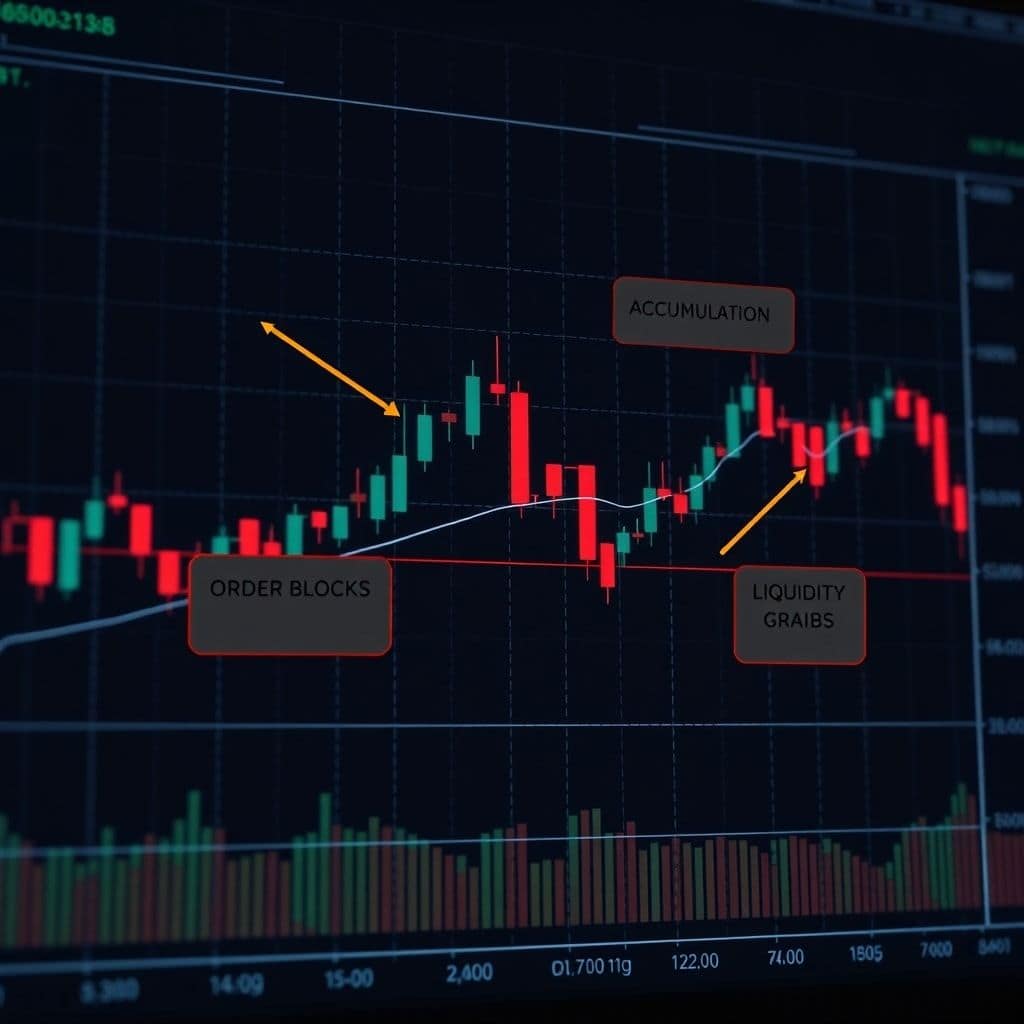
Identifizierung von Smart Money Fußabdrücken im Chart
While Smart Money operates behind the scenes, their actions leave discernible patterns on price charts. Learning to interpret these “footprints” is key to applying **Smart Money Konzepte** effectively.
Order Blocks
An order block is a specific candlestick pattern that represents an area where institutions have placed a significant number of orders. Typically, it’s the last bearish candle before a strong bullish move, or the last bullish candle before a strong bearish move. When price returns to this “block” in the future, it often finds support or resistance, as institutions may have residual orders to fill.
Identifying valid order blocks requires careful analysis of price action and context, as not all such candles are significant. This is a powerful tool within **Smart Money Konzepte** for pinpointing potential reversal or continuation points.
Imbalance / Fair Value Gaps (FVG)
Imbalance, also known as a Fair Value Gap (FVG), occurs when there’s a strong, rapid price movement where buying or selling pressure is so overwhelming that there isn’t enough opposing pressure to create a “fair” exchange of orders. This leaves a gap in the price action, often represented by a three-candlestick pattern where the high of the first candle doesn’t overlap with the low of the third candle (for a bullish FVG) or vice versa.
Smart Money often retests these imbalances later to “fill the gap” or rebalance the order flow. Recognizing and trading these areas is a sophisticated application of **Smart Money Konzepte**.
Strukturbrüche und Marktstrukturverschiebungen (BOS/CHoCH)
Market structure refers to the sequence of higher highs and higher lows (uptrend) or lower highs and lower lows (downtrend). A “Break of Structure” (BOS) occurs when price continues the existing trend by breaking a previous high in an uptrend or low in a downtrend. A “Change of Character” (CHoCH) signifies a potential reversal, where price breaks a previous significant high in a downtrend or low in an uptrend.
Smart Money often initiates these shifts in market structure. By observing these BOS and CHoCH patterns, traders can identify when institutions are changing their bias and positioning for a new trend. This forms a foundational element of many **Smart Money Konzepte** strategies.
Commitment of Traders (COT) Report
While not a direct chart pattern, the Commitment of Traders (COT) report, published weekly by the CFTC, provides a glimpse into the positioning of large institutional traders in futures markets, including currency futures. It separates participants into “Commercials” (hedgers), “Non-Commercials” (large speculators like hedge funds), and “Non-Reportables” (small speculators).
Analyzing the net long/short positions of Non-Commercials can offer insights into the overall sentiment and potential future movements of Smart Money. While not directly applicable to spot Forex, it provides a broader context often used in conjunction with technical **Smart Money Konzepte** analyses. You can access the latest COT reports on the CFTC website for detailed data.
Integration von Smart Money Konzepte in Ihre Handelsstrategie
Simply identifying these institutional footprints is not enough; successful application requires careful integration into a robust trading plan.
Bestätigung durch mehrere Faktoren
Never rely on a single Smart Money concept in isolation. Always seek confluence from multiple factors. For example, an order block that aligns with a significant support/resistance level, a Fair Value Gap, and a shift in market structure presents a much higher probability setup than an isolated pattern.
Combining these insights with traditional technical analysis tools like moving averages or Fibonacci retracements can further strengthen your conviction. This multi-faceted approach is key to mastering **Smart Money Konzepte**.
Risikomanagement und Positionsgröße
Even with the most advanced **Smart Money Konzepte**, no trade is guaranteed. Proper risk management is paramount. Always define your stop-loss levels based on logical market structure (e.g., just beyond an order block or FVG) and calculate your position size such that you risk only a small percentage (1-2%) of your capital per trade.
Institutions themselves employ sophisticated risk management, and retail traders should emulate this discipline. Protecting your capital is always the top priority.
Geduld und Disziplin
Trading with **Smart Money Konzepte** often requires immense patience. High-probability setups do not occur every hour. You might need to wait for price to retrace to a specific order block or for an imbalance to be filled before entering a trade. Chasing trades or overtrading out of impatience will quickly erode your capital.
Discipline is also crucial in sticking to your trading plan, managing emotions, and avoiding impulsive decisions. The market provides ample opportunities for those who wait for the right moment.
Häufige Fallstricke und wie man sie vermeidet
While powerful, **Smart Money Konzepte** are not a magic bullet. Traders can fall into common traps:
-
Übermäßige Komplexität: Trying to incorporate too many concepts at once can lead to analysis paralysis. Start with a few core concepts and master them before adding more.
-
Fehlinterpretation: Not every “gap” is an FVG, and not every strong candle is an order block. Context is everything. Practice identifying genuine institutional footprints.
-
Mangel an Backtesting: Before trading live, thoroughly backtest any Smart Money strategy on historical data to understand its efficacy and nuances.
-
Ignorieren des übergeordneten Trends: Even the best Smart Money entry can fail if it goes against the dominant higher timeframe trend. Always consider the bigger picture.
Avoiding these pitfalls requires continuous learning, practice, and a commitment to refining your understanding of **Smart Money Konzepte**.
Fazit: Die Macht der Smart Money Konzepte nutzen
Understanding and applying **Smart Money Konzepte** in Forex trading offers a significant edge to retail traders. By learning to decipher the actions of banks and institutions, you move beyond reactive trading to a more proactive and informed approach. We’ve explored what Smart Money is, how these powerful players move the market through tactics like stop hunts and accumulation, and how to identify their footprints using tools like order blocks, imbalances, and market structure shifts.
Remember, success hinges on combining these insights with rigorous risk management, patience, and continuous learning. Embrace the challenge of thinking like an institution, and you’ll be better equipped to navigate the complexities of the Forex market. Start incorporating these powerful **Smart Money Konzepte** into your analysis today and elevate your trading journey.
Ready to deepen your understanding? Explore advanced price action analysis techniques and delve into specific institutional trading models to further refine your edge in the market.
Leave a Reply